Your YouTube CTR went up, but views went down—or at least they did not rise enough to matter. That result feels like a contradiction, but it usually means one metric moved faster than the others. Impressions CTR only counts registered thumbnail impressions, so it can improve while reach stays flat if the audience mix, traffic source mix, or timing changed.
What the CTR number actually measures
- Impressions CTR
- The share of registered YouTube thumbnail impressions that turned into views. It is not total views divided by total impressions, because some views do not come from a registered thumbnail impression.
- Why the same package can look different
- CTR varies with audience, content, video age, and the surface where the impression appears. A title and thumbnail can perform one way on Home, another in Suggested videos, and another in Search, so a blended CTR can hide the real shift.
- What belongs in the comparison
- Browse features, Suggested videos, YouTube Search, channel pages, notifications, external sources, playlists, and end screens are separate traffic categories. They are not interchangeable versions of one packaging score.
That is why a higher CTR can still show up with low impressions. Sometimes the package is reaching a narrower or more loyal audience, which clicks more often but does not widen distribution. In other words, the click rate can improve while the audience gets smaller.
The three explanations worth checking first
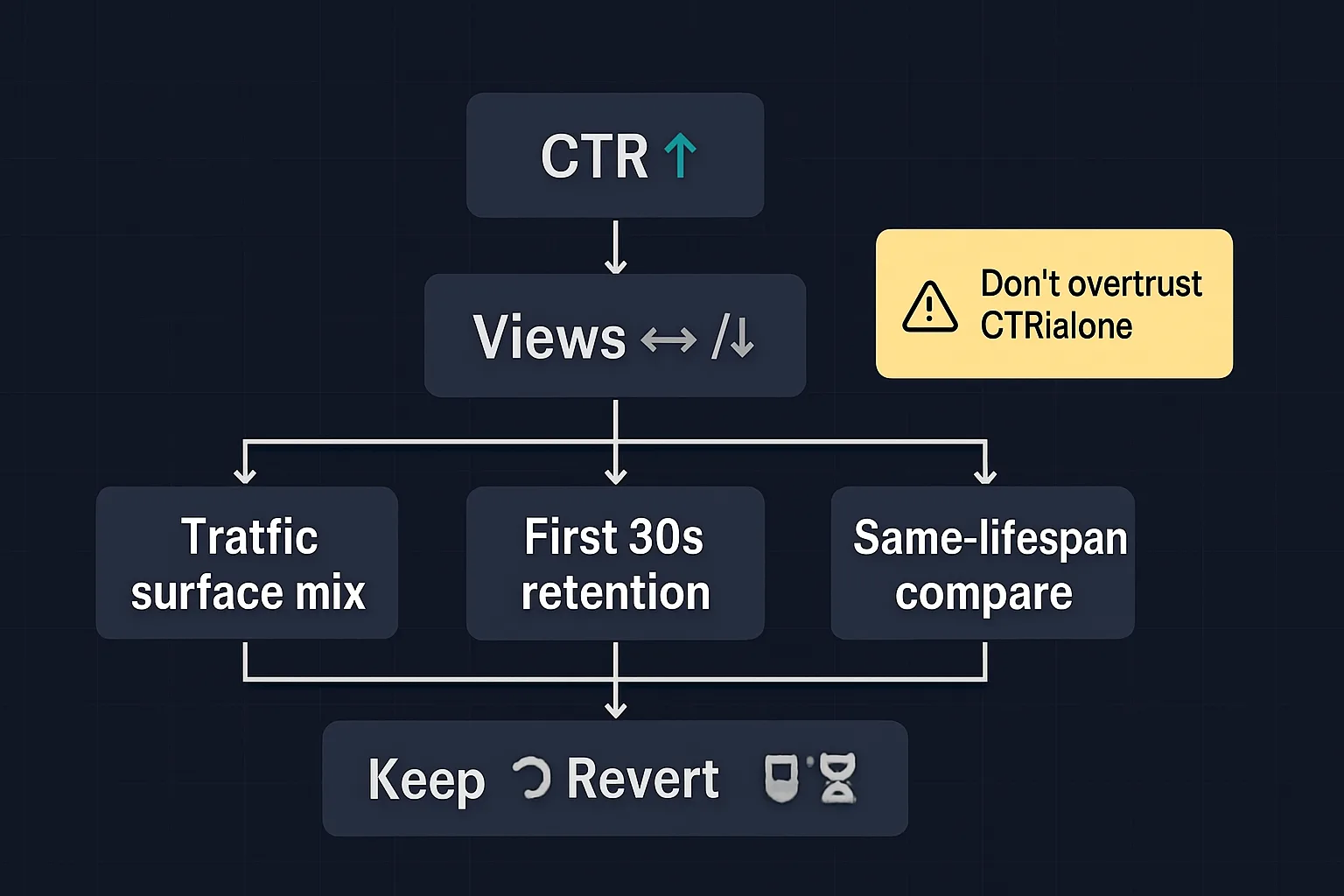
1) The traffic mix shifted
Use this branch when: the video is being shown on different surfaces than before.
If lower-CTR Suggested traffic shrinks while a more loyal source such as channel-page traffic, notifications, or a subscription-heavy surface becomes a larger share, the blended CTR can rise even as total views stagnate. The important question is not whether the average number moved, but which source changed.
What to check: source-level impressions, views, watch time, and CTR. That tells you whether the video is really being distributed differently, instead of forcing every traffic source into one combined verdict.
2) The click improved, but the session did not
Use this branch when: CTR rose, but watch time or early retention did not keep up.
YouTube’s Intro retention measure is the percentage of viewers still watching after the first 30 seconds. A strong intro can mean the opening matched the expectation set by the title and thumbnail, but it can also mean the opening simply held interest. If CTR moved up while Intro retention moved down, the click may be outrunning the content—or the opening changed at the same time.
3) The comparison is too early to trust
Use this branch when: the sample is thin, the video ages do not match, or you keep checking the result as it changes.
Manual before-and-after swaps are exposed to time, changing audience composition, and shifting demand. A short run can look decisive before it is actually stable. General experimentation research also warns that repeated checking and data-dependent stopping can make an ordinary fixed-sample read unreliable unless the process was planned that way from the start.
The Analytics workflow that separates signal from noise
- Match the lifespan first. Compare the changed video against similar videos at the same age. Use the first 24 hours, 7 days, or 28 days rather than mixing a fresh upload with a mature one. YouTube’s Advanced Mode supports same-lifespan comparisons, which helps separate video-age effects from packaging effects.
- Break the result out by traffic source. Look at Browse features, Suggested videos, Search, channel pages, notifications, external sources, playlists, and end screens separately wherever your report allows it. Compare source-level impressions, views, watch time, and CTR. If one source loses volume while another gains it, the blended CTR is not telling the whole story.
- Check whether the audience composition changed. Compare subscribed and non-subscribed viewers when that breakdown is available. A loyal audience often behaves differently from a cold audience, and that can move the overall CTR even if the package itself did not improve.
- Read first-30-second retention in context. If CTR improved and Intro retention improved too, that is stronger corroborating evidence that the package and the opening are aligned. If CTR improved but Intro retention weakened, the click may be pulling in viewers whose expectations are not being met, or the opening itself may need work.
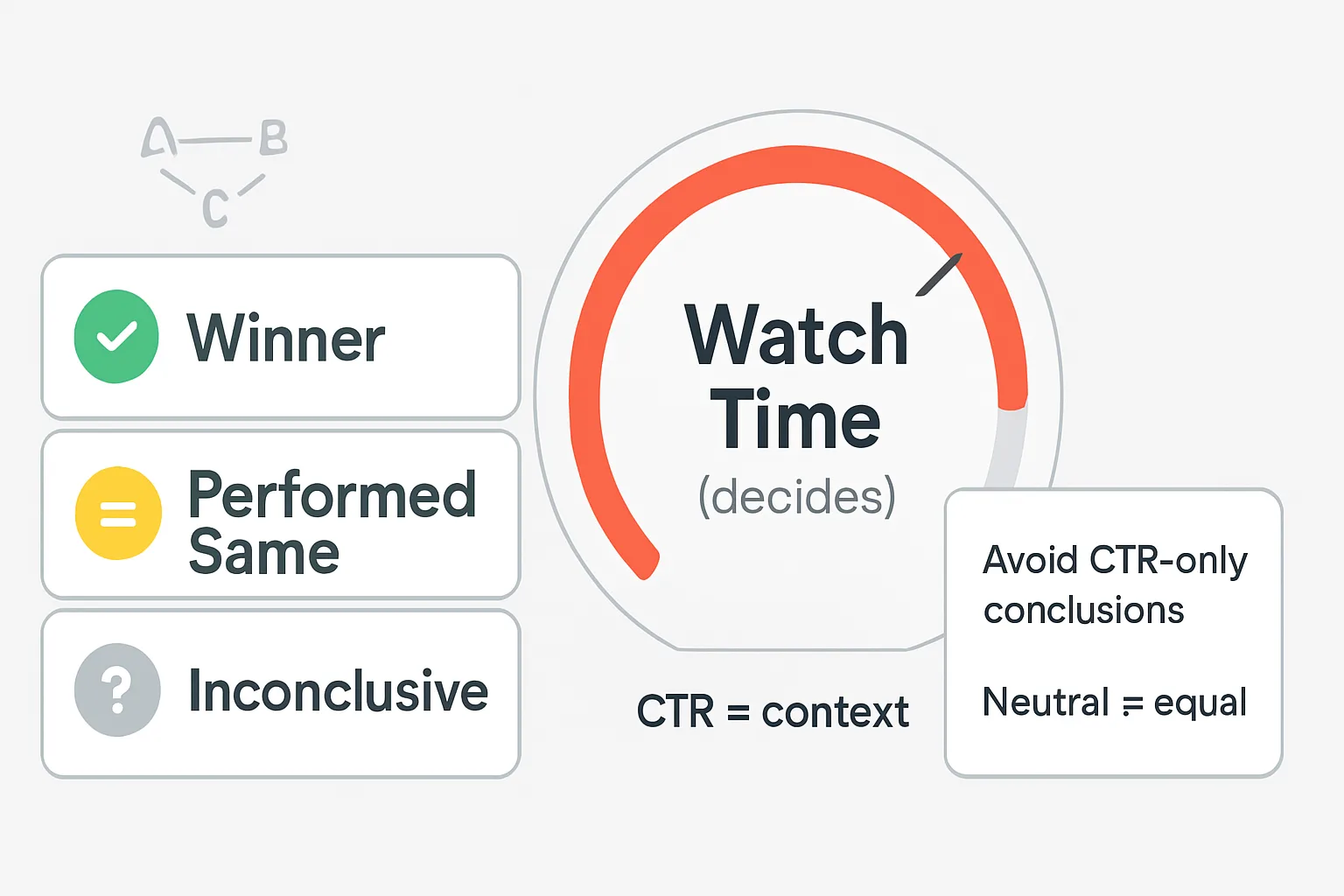
- Document the test conditions before you act. Note the exact title or thumbnail change, when it went live, the video age, the traffic mix, and whether the opening changed at the same time. If you used YouTube’s native title-and-thumbnail test, remember that it can compare up to three variants concurrently, it chooses a winner by watch time rather than CTR alone, and its result labels mean different things: Winner supports adoption, Performed Same suggests no meaningful difference, and Inconclusive means the evidence is not strong enough for a confident switch.
How to decide whether to keep, revert, or keep watching
Keep the change when the higher CTR survives a same-lifespan comparison, source-level impressions and views do not point to a hidden traffic-mix shift, and watch time or early retention does not fall. That is the closest thing to a practical win.
Revert or revise it when the CTR lift is concentrated in a narrow pocket of repeat viewers while broader reach weakens, or when the people who click are leaving earlier than before. In that case, the package may be attracting the wrong expectation.
Keep watching when the result is still young, the sample is thin, or the traffic regime is still moving. Do not stop on the first green day. If the result is Inconclusive, treat it as a reason to observe longer or test again under clearer conditions—not as proof that the new title or thumbnail worked.
The safe read is simple: a higher YouTube CTR is useful only after you know which impressions produced it and whether the audience stayed. Once you separate traffic sources, align the timing, and read first-30-second retention in context, the mismatch becomes much easier to explain without overclaiming what the data can prove.