Your tutorial has started picking up impressions, but the pattern feels off. Search viewers click sometimes and leave early, while the same video may look stronger in Home or Suggested. That usually means the problem is not simply “more keywords.” It is a mismatch somewhere between the query, the click, and the opening.
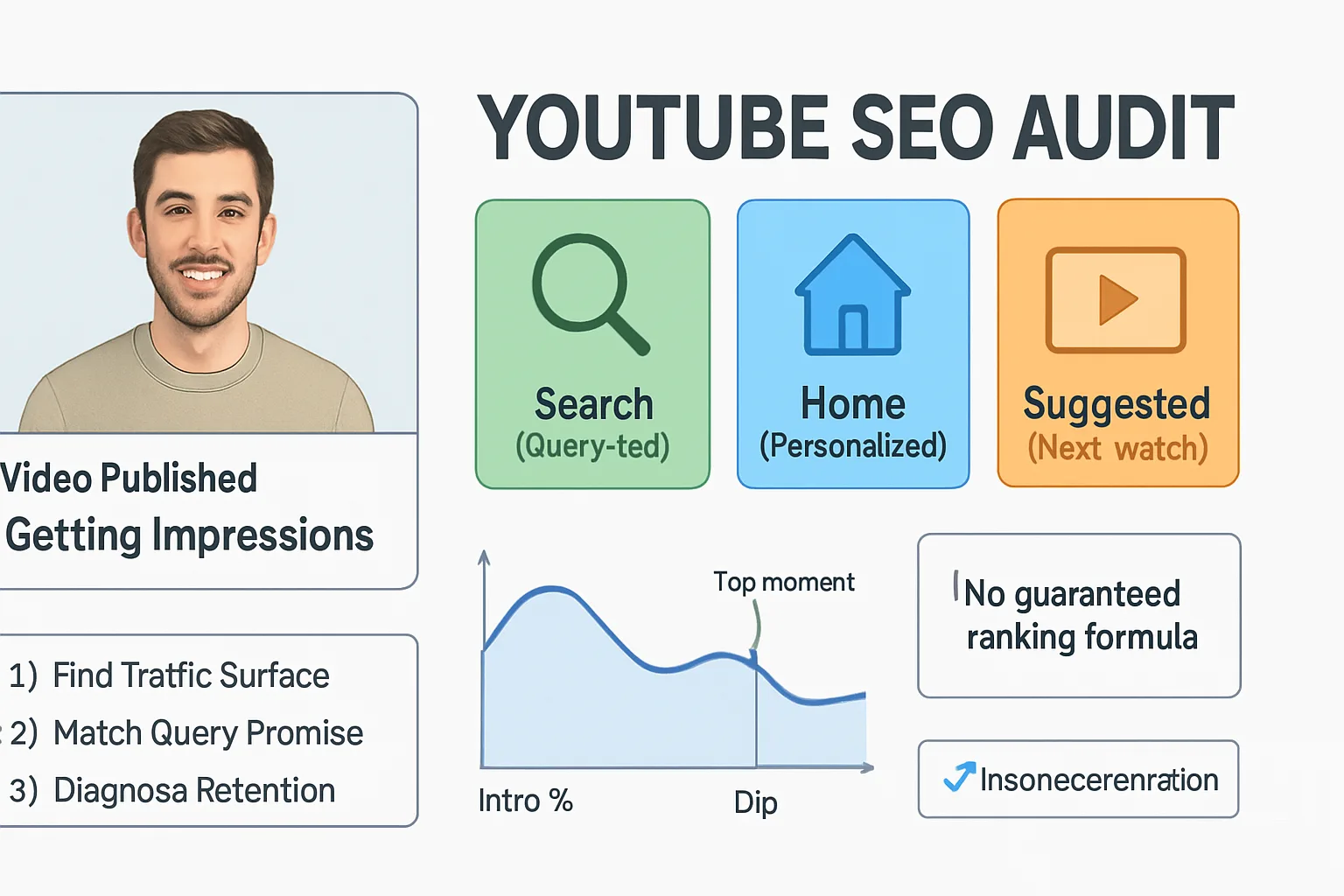
A useful YouTube SEO audit starts with one question: which discovery surface is actually sending viewers? Search, Home, and Suggested are different contexts. Search is query-led, Home is personalized, and Suggested is tied to what someone may watch next. If you blur those together, you can end up optimizing the wrong problem.
Identify the surface before you read the numbers
Open YouTube Studio → Analytics → Reach and check How viewers find this video. That is where you can separate YouTube Search from Browse features and Suggested videos. The Reach tab can also include the YouTube Search terms report, which is the most direct way to see what viewers actually typed before they found the video. YouTube’s Reach help page explains where those traffic-source reports live.
Use that report as a diagnostic starting point, not a victory lap. Search traffic can hint that a title and description are connecting with a query, but it does not prove they are fully optimized. It also will not show every low-volume term, so the visible queries are evidence, not a complete inventory.
Compare the query promise with the video itself
Once you have the query, compare it with the promise the video makes. YouTube says Search ranking considers relevance, engagement, and quality, and that relevance can include how well the title, tags, description, and video content match the query. The key word there is match. A keyword in the title is not enough if the video answers a different question.
| Audit area | What to ask | What a mismatch may look like |
|---|---|---|
| Title | Does it clearly reflect the search intent? | The wording attracts one type of viewer, but the video solves a different problem. |
| Description | Does it reinforce the same answer or outcome? | The description is vague, broad, or focused on a side topic. |
| Opening | Does the first 30 seconds address the searched-for problem? | The video spends too long setting context before getting useful. |
| Full answer | Does the video actually resolve the query? | The answer is incomplete, delayed, or aimed at the wrong viewer. |
For example, if the Search term is “how to remove background noise from a podcast,” the title may be relevant, but the audit should keep going. Does the opening demonstrate the fix quickly? Does the content stay on podcast audio, or does it drift into unrelated editing tips? That is the difference between a broad keyword match and a real intent match.
Read the first 30 seconds as a promise check
In Audience retention, look at the Intro metric. YouTube uses that metric for viewers still watching after the first 30 seconds. The help documentation also says a strong Intro percentage can indicate that the opening matched the title and thumbnail expectation and kept viewers interested. That makes the first 30 seconds one of the most useful places to look for a Search problem.
YouTube’s retention guidance also points to dips, spikes, and top moments. Those are not ranking formulas. They are clues.
- Sharp early drop: the viewer may have expected an answer that arrives later, or a different answer entirely.
- Slow decline after a long setup: the video may be delaying the practical part for too long.
- Dip at one section: viewers may be skipping or abandoning that portion, though the chart alone cannot prove why.
- Late top moment: the strongest material may appear too far into the video, which is a useful clue for future edits.
The point is not to chase a universal retention target. There is no official percentage that guarantees ranking. The point is to see whether the opening fulfills the same promise made by the query, title, and thumbnail expectation.
Use CTR only after you know the surface
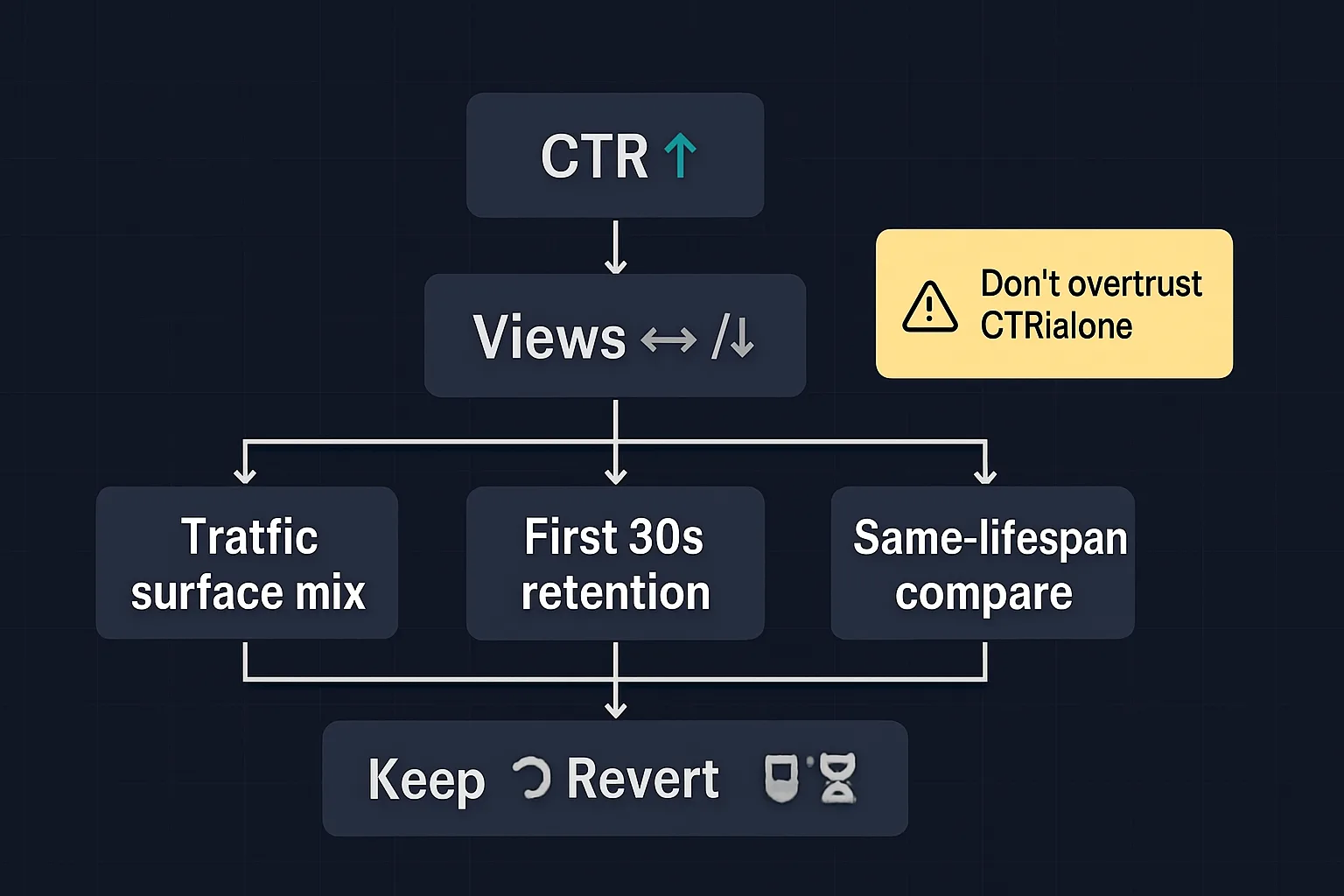
Click-through rate can help, but only in context. YouTube says CTR varies by traffic source, audience, and content, and warns against evaluating it too early or in isolation. Search viewers are usually in an active-answer mindset, while viewers on Home are often browsing more broadly, so the same video can produce very different CTR patterns on different surfaces.
That is why a Search CTR should be compared with other videos of similar intent on your own channel, not with a universal benchmark. A high CTR does not guarantee more impressions, and a stronger CTR combined with strong watch behavior still does not promise continued growth. Topic size, competition, and audience availability all matter.
A compact YouTube SEO audit checklist
- Confirm that the video is getting traffic from YouTube Search, not just general impressions.
- Open the Search terms report and note the exact queries that produced views.
- Write the answer each query seems to request in one sentence.
- Compare that sentence with the title, description, opening, and actual answer delivered.
- Review the Intro metric for the first 30 seconds.
- Check dips, spikes, and top moments for signs of where viewer expectation changes.
- Read CTR alongside the traffic source, not as a standalone score.
What Search data can tell you: which surface brought viewers, which queries are visible, whether the title and description seem aligned, and where early retention changes.
What it cannot tell you by itself: a guaranteed ranking position, a universal CTR target, or the exact cause of every dip and spike.
YouTube does not describe Search ranking as a single keyword-density formula or a guaranteed checklist. The cleaner audit is the one that follows the viewer’s path: identify Search traffic, compare the query with the promise, and inspect whether the opening delivers the answer quickly enough. That gives you a clearer diagnosis than changing metadata blindly, and it keeps Search separate from Home or Suggested performance.