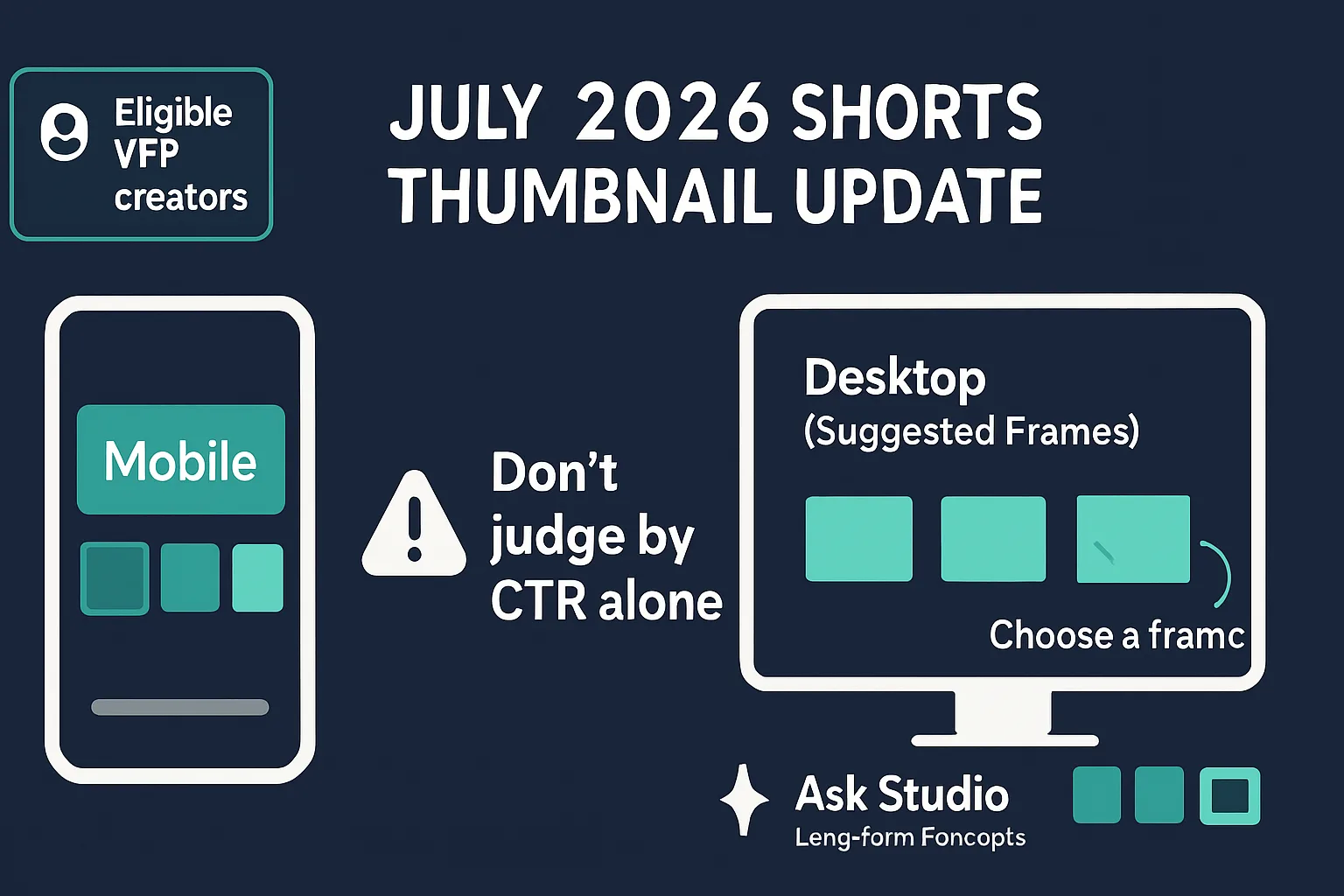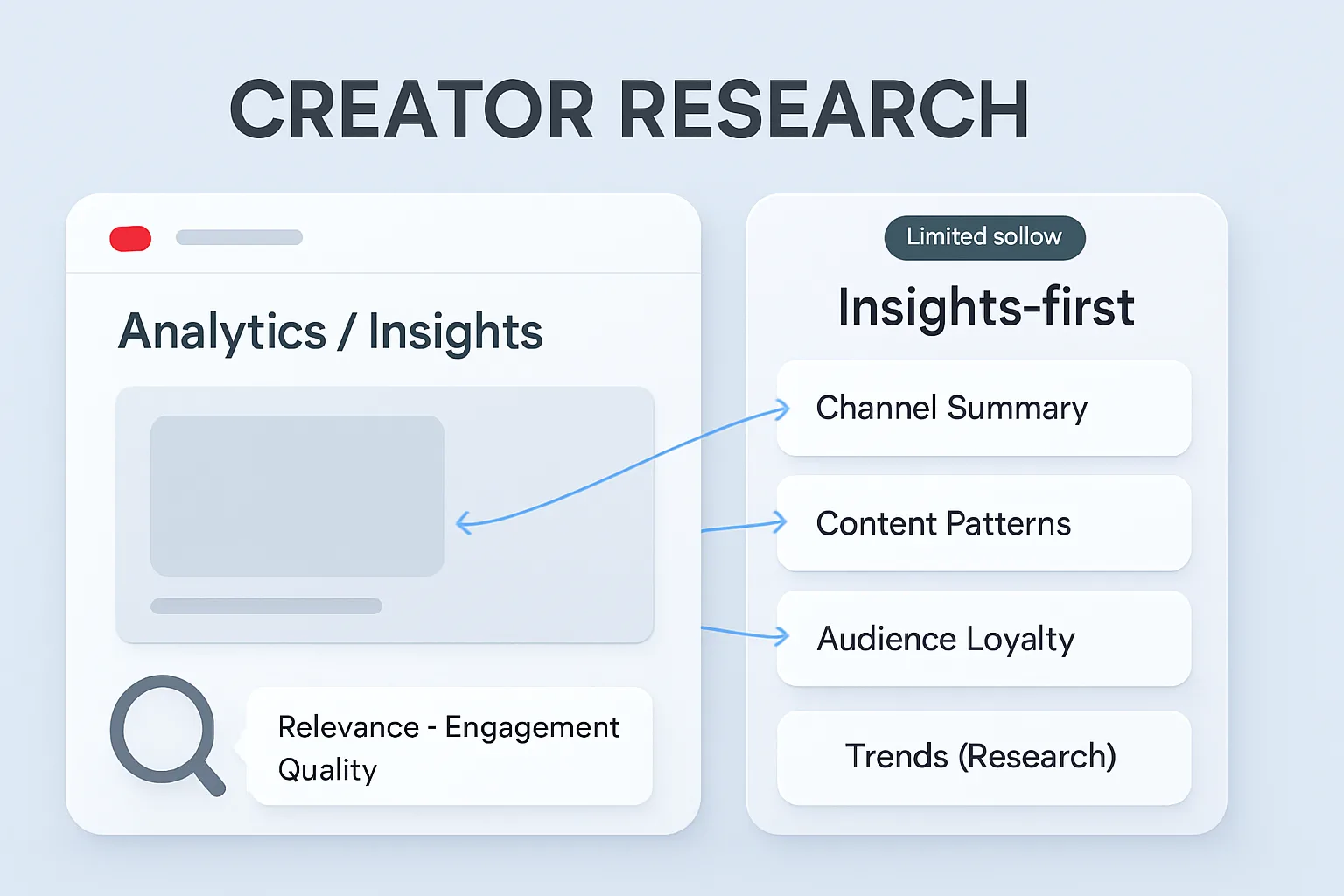
YouTube is testing an insights-first Studio experience that puts faster interpretation ahead of raw chart-hunting. The experiment adds AI-generated insight cards for areas such as channel summaries, content patterns, audience loyalty, and individual video summaries. YouTube is also exploring a more research-oriented direction for the Trends experience.
For creators, that could make Studio feel less like a reporting dashboard and more like a planning workspace. But there is an important catch: the desktop test is only rolling out to a small group of creators. It is not a universal replacement for YouTube Analytics, and it does not announce a new ranking system.
Quick read: YouTube is testing a faster way to surface patterns and research ideas. Treat it as an early product signal, not as a reason to rebuild your entire workflow.
What changed in YouTube Studio
Analytics is being tested as an insights-first experience
The goal of the experiment is to help creators spot performance trends more quickly. Instead of expecting every creator to piece together multiple reports manually, the updated interface can place summaries and observations closer to the front of the Studio workflow.
That matters because analytics is only useful when it leads to a decision. A creator may want to know which topics are gaining momentum, which formats encourage repeat viewing, or where audience loyalty is strongest. A guided summary can make those questions easier to investigate, especially once a channel has enough videos for patterns to become hard to see at a glance.
AI-generated cards summarize several parts of channel performance
The test includes AI-generated cards covering:
- Channel summaries that give a higher-level view of what is happening across the channel.
- Content patterns that may highlight recurring relationships between topics, formats, publishing behavior, and performance.
- Audience loyalty signals that may help creators understand returning or consistently engaged viewers.
- Video summaries that surface more focused observations about individual uploads.
Those cards should be treated as starting points for investigation, not as final answers. An auto-surfaced pattern can tell you where to look; it cannot replace knowledge of your audience, the context of a particular upload, or a careful comparison with similar videos.
The Trends tab is moving toward a research workflow
YouTube is also experimenting with evolving the Trends tab into a broader Research destination for video ideation. That direction is notable because it connects audience discovery with content planning before a video is made.
The existing Trends workflow can help creators research what their audience and viewers across YouTube are searching for. Depending on availability, it may surface top searches, breakout videos from similar channels, recent videos related to audience interests, and content gaps.
Top searches in the updated experience are based on audience activity and saved searches from the previous 28 days. Content gaps identify searches where viewers may not have enough relevant, exact-match, current, or high-quality results. Those signals can help a creator find a promising question to answer, but they do not automatically validate the idea or guarantee demand after publication.
What the experiment appears to include
| Studio area | Familiar workflow | Experimental direction | What it means for creators |
|---|---|---|---|
| Performance review | Open reports and interpret the charts manually. | Insights-first cards summarize channel and video patterns. | Use summaries to find questions worth checking in the underlying data. |
| Content analysis | Compare topics, videos, and audience behavior on your own. | AI cards may highlight content patterns and audience loyalty. | Look for repeatable evidence, not just a convenient narrative. |
| Idea research | Use Trends to explore audience searches and related activity. | YouTube is testing a more research-focused destination for ideation. | Turn research signals into a brief, then apply human judgment. |
| Availability | Core Studio tools are broadly familiar, though features can vary. | The insights-first desktop experiment is limited to a small group of creators. | Do not assume another creator’s screenshots are available in your account. |
Who may see it and why that matters
The insights-first Studio experience is being tested with a small group of creators. That means access may depend on account eligibility, device, rollout stage, or other conditions YouTube has not made universal.
A limited experiment creates two common sources of confusion. First, a creator may read about a feature that is not present in their own Studio. Second, early users may describe a tested interface as if it were already the standard product. Neither is a reliable reason to change your publishing process.
The same caution applies to Trends. Insights can be limited by country, language, device, and the availability of relevant videos. A missing search, content gap, or audience signal does not necessarily mean viewers have no interest in the subject.
What creators should infer, and what they should not
The useful signal
The experiment points toward more guided research and faster pattern recognition inside YouTube Studio. YouTube appears to be making it easier for creators to connect three activities that are often separated: reviewing past performance, understanding the audience, and choosing the next topic.
That direction is useful for creators who already have a disciplined review process. An insight card may reduce the time needed to spot a possible pattern, while the research experience may help turn that pattern into a specific video idea.
The limit
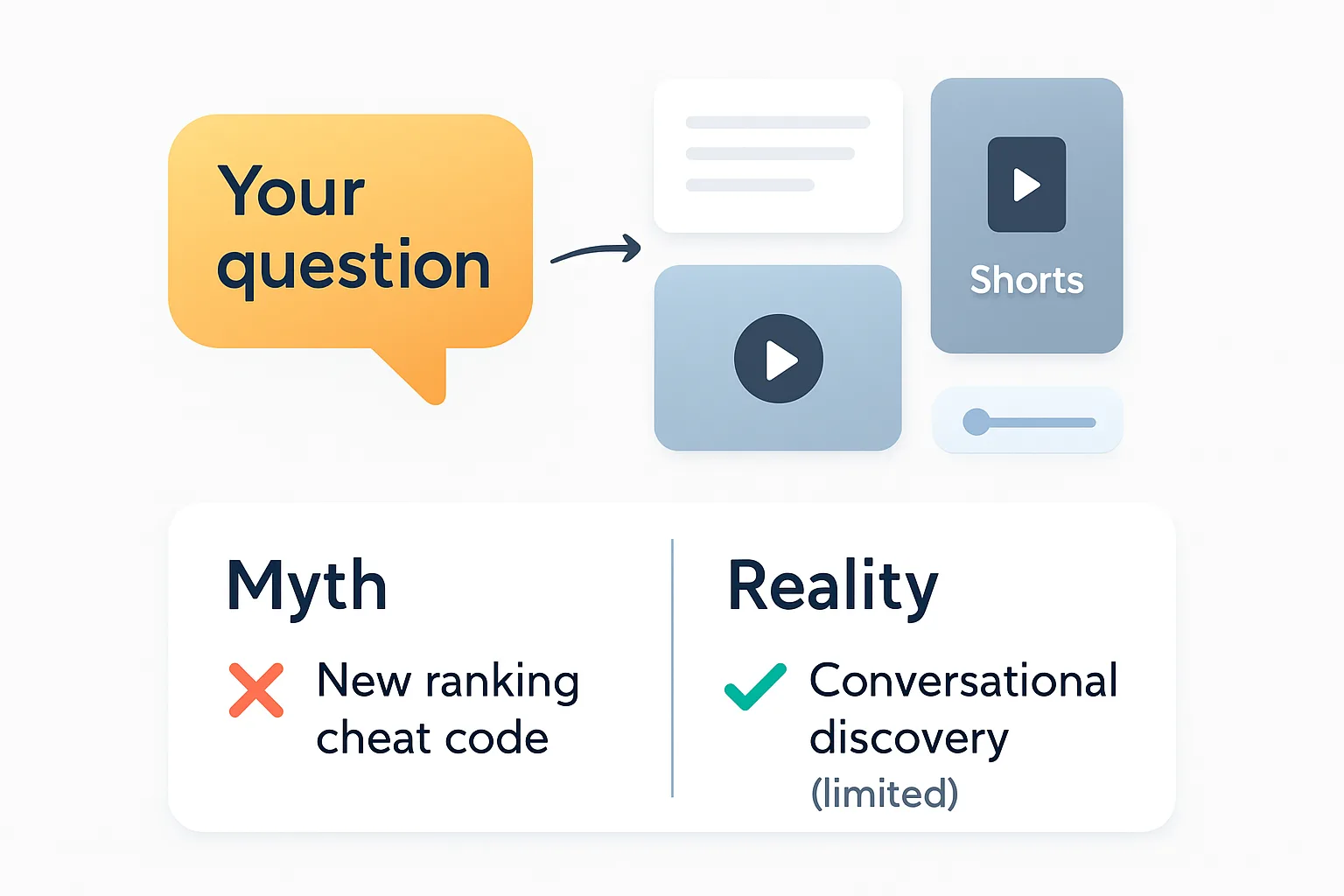
This does not establish a new official ranking formula. YouTube says search ranking is driven by three main elements: relevance, engagement, and quality. Relevance can include the title, tags, description, and video content, rather than keywords in isolation.
YouTube’s discovery systems are also personalized rather than governed by one universal ranking order. That means search results can differ between viewers, and the system may use signals such as search history, watch history, video performance, engagement, average view duration, and average percentage viewed.
Put simply, the new experiment may help you research ideas faster, but it does not change the basic reality of discovery: a video still has to match the viewer’s intent and satisfy that intent well.
Practical moves to make now
- Check your own Studio before planning around the test. Look for any new insights or research features in the desktop experience, but do not assume that a feature described elsewhere has reached your account.
- Keep your existing measurement baseline. Continue tracking impressions, click-through rate, average view duration, average percentage viewed, audience retention, traffic sources, and returning-viewer behavior where those metrics matter to your goals.
- Use insight cards to form questions. If a card suggests that a topic or format is performing differently, compare several related videos and review the time period before drawing a conclusion. For example, if the card says tutorials are holding attention better than vlogs, check whether that holds across the last month or only one upload.
- Turn Trends signals into a video brief. Write down the viewer’s likely question, the specific promise of the video, the evidence you will show, and why your version is useful now.
- Check the search result yourself. Review the current videos, their age, the exact questions they answer, and whether the apparent gap is about relevance, quality, freshness, or a missing format.
- Do not force keywords into the script. Use the language viewers actually use where it improves clarity, but make the video satisfy the underlying intent rather than repeat an exact phrase.
This approach keeps the new tools in perspective. Research can reveal demand. Analytics can reveal behavior. The creator still has to decide what deserves to be made and how to make it genuinely useful.
Frequently asked questions
Is the insights-first Studio experience available to every creator?
No. The desktop experience is an experiment rolling out to a small group of creators, so availability should not be treated as universal. Your Studio may continue to show the familiar Analytics workflow even if another creator has access to the test.
Does the experiment replace YouTube Analytics for everyone?
No. The tested interface is better understood as an insights-first presentation of channel information, not a confirmed universal replacement for Analytics. Core reports and feature names may change as YouTube evaluates the experiment, but creators should use the tools actually available in their accounts.
Should creators change their keyword or research workflow right away?
Not because of the experiment alone. You can use Trends and other available research tools now, but validate ideas against search intent, competing results, audience fit, and your ability to deliver a strong video. A new summary card should support that process, not replace it.
Is the Trends tab now a universal Research tab?
No. YouTube is experimenting with a more research-oriented direction, but the experience and its insights may vary by account, country, language, device, and available data. Treat reports about a broader Research destination as an indication of product direction rather than a guarantee that every creator has the same interface.
YouTube’s insights-first experiment is worth watching because it brings performance interpretation and video research closer together. AI-generated cards may help creators find patterns faster, while a more research-focused Trends experience may make it easier to move from audience questions to viable ideas.
For now, the sensible response is verification rather than overreaction. Check whether the tools are available to you, keep using dependable performance metrics, and test any insight against the underlying evidence. The experiment may point toward a more guided Studio workflow, but until the rollout expands and the product becomes clearer, your best advantage remains the same: understand the viewer’s intent and make the video that fulfills it well.