Before changing the wording, state what a viewer should believe they will get from the video. If that expectation is hard to express accurately, a YouTube title can get clicks but low retention because the discovery surface, package, opening, and payoff point in different directions. This audit helps locate that divergence without assuming the title caused every early exit.
- The promise chain
- The promise chain is an editorial heuristic: the discovery surface, title, thumbnail, opening, and delivered payoff should lead toward one accurate viewer expectation. It is not an official YouTube metric or a score that predicts performance. YouTube describes titles and thumbnails as packaging that communicates value and sets expectations; this chain makes that relationship easier to inspect before publishing.
The click is not the whole promise
A click shows that the package was compelling enough to start. It does not show that the video immediately confirmed the specific reason for the click. YouTube guidance connects packaging with expectation setting and advises creators to deliver the communicated value in the opening. That is platform guidance, not proof that one mismatch produces a particular retention decline.
Limited independent evidence supports treating mismatch as a viewer-experience question. A small qualitative study of 21 young viewers reported that participants compared title-and-thumbnail signals with the content they received, with mismatch associated with dissatisfaction and negative reactions. It is not representative or causal YouTube-wide evidence, but it reinforces the value of checking the promise before publication.
A short mismatch example
Imagine a video titled “Build a Quiet Desk Setup for Under $300”. Its thumbnail suggests a complete room makeover, while the opening discusses renovation plans before showing the desk or explaining the budget.
The title makes a specific, affordable desk promise; the image implies a broader transformation; and the opening delays both. The audit does not claim the title caused a retention drop. It identifies the first apparent conflict for revision: the visual emphasis and opening do not quickly reinforce the subject the title made concrete.
Check the discovery surface before rewriting
Begin with where viewers are likely to encounter the package. An accurate title can still use the wrong language for the surface introducing it.
Search needs a recognizable subject
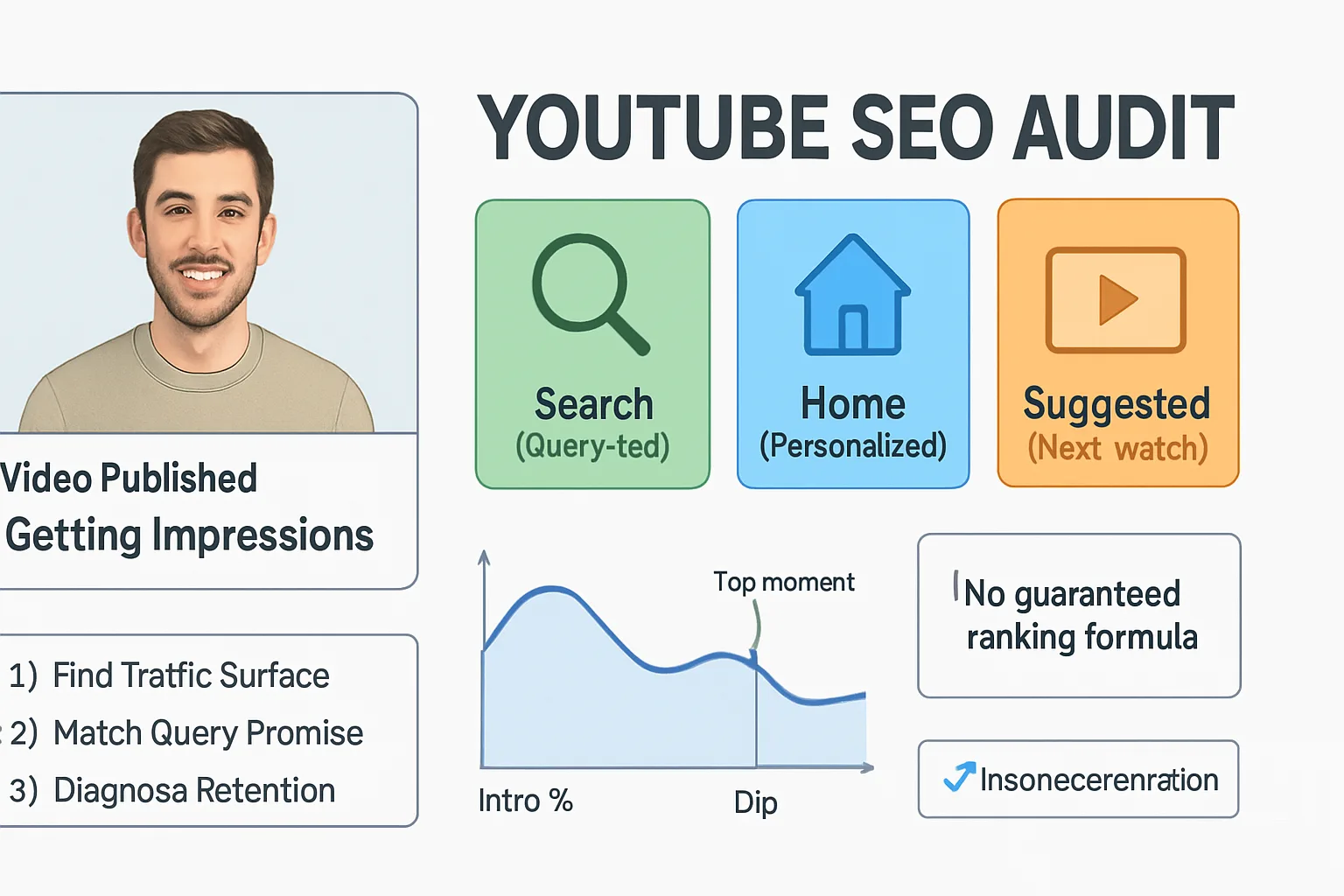
YouTube says Search relevance includes how well the title and video content match a viewer’s query, alongside engagement and quality. Inspect a plausible query and ask whether the title identifies the subject and the video actually addresses it. Matching a query is one relevance signal, not a ranking, impressions, or retention guarantee. A deeper YouTube Search audit can extend this check after the promise review.
Audience tools may reveal titles, topics, thumbnails, and formats watched outside your channel. Trends may show top searches, related activity, and breakout videos, although availability varies by country, language, and device. Popularity alone does not establish that a query fits your video.
Browse can invite curiosity without hiding the subject
YouTube distinguishes clear descriptions of searchable subjects from titles intended to spark curiosity. Treat that as an editorial distinction, not a fixed Search-versus-Browse formula. A useful test is whether viewers can infer the likely value without inventing details the video never delivers.
Check whether title and thumbnail make one claim
Read each element alone, then read them together. They can add information, but they should not create competing central promises. If the title names a specific result and the thumbnail implies a different transformation, choose the expectation the video genuinely supports.
Check accuracy as well as brevity. Curiosity is not automatically deceptive, but packaging crosses a policy boundary when it represents the video as something it is not or is designed to mislead viewers. Preserve the interesting angle while removing an unsupported result, exaggerated scope, or visual suggestion the video cannot substantiate. YouTube’s misleading-metadata policy sets that boundary.
Check the opening against the expectation
Compare the first moments with the belief created by the package. Does the opening identify, demonstrate, or advance the promised value? Or does it introduce another topic, delay the subject, or make viewers reconstruct what they clicked for?
“Deliver early” is an audit principle, not a universal intro formula. The promised value should become recognizable soon enough for viewers to understand that the video addresses their expectation. Depending on the topic, that might mean a result, a framed question, a demonstration, or the first useful step.
YouTube defines its intro metric as the percentage of viewers still watching after the first 30 seconds. It can reveal an opening pattern worth examining, but it cannot uniquely diagnose a title failure. A dip may reflect expectation mismatch, delayed delivery, topic or audience fit, continued-interest differences, or other viewer behavior. Review the opening and traffic context alongside YouTube’s retention guidance; there is no universal target supplied here.
Choose the element to revise
Use this original rubric as a prioritization aid. Score each question 0 for unclear or unsupported, 1 for partly aligned, or 2 for clearly aligned. The total is an editorial snapshot, not an official metric, predictive score, or causal rule.
- Discovery fit: Does the likely Search query or Browse context make the subject and value understandable?
- Title claim: Is the central result, question, or tension specific enough for the full video to support?
- Thumbnail relationship: Does the image add context without making a separate or larger promise?
- Opening delivery: Does the beginning make the promised value recognizable?
- Payoff integrity: Does the finished video resolve, demonstrate, or explain what the package led viewers to expect?
Revise the lowest-scoring element first. Rewrite the title when its central claim is vague or unsupported. Revise the thumbnail when its visual emphasis creates the wrong expectation. Change the opening or its order when the package is accurate but delivery is delayed. If package and delivery align while the response remains unclear, revisit topic or audience fit before blaming the title.
Validate the hypothesis without overreading the metrics
After publication, treat the audit as an alignment hypothesis rather than a verdict. Examine retention in useful segments when available, including new and returning viewers, subscribers and non-subscribers, or organic and paid traffic. A pattern limited to one segment or traffic context weakens a simple title-only explanation.
YouTube’s native title-and-thumbnail testing compares combinations and uses watch-time share rather than CTR alone when selecting a winner. That supports evaluating packaging beyond clicks, while audience composition and statistical interpretation still matter. Watch-time share is not identical to satisfaction, and a test does not prove that the title alone caused its outcome.